 |
|
|
Lucinda DEVLIN *1947 Ann Arbor, Michigan (USA), lives /works in Indianapolis
Thomas FLORSCHUETZ *1957 Zwickau (Germany), lives / works in Berlin
Evelyn HOFER *1922 Marburg a.d. Lahn (Germany), † 2009 Mexico City
Aino KANNISTO *1973 Espoo (Finland), lives / works in Helsinki
Laura LETINSKY *1962 Canada, lives / works in Chicago
Melanie MANCHOT *1966 Germany, lives / works in London
Simone NIEWEG *1962 Bielefeld (Germany), lives / works in Düsseldorf
Dirk REINARTZ *1947 Aachen (Germany), † 2004 Buxtehude
Peter WEGNER *1963 Sioux Falls, South Dakota (USA), lives / works in Berkeley and San Francisco
|
 Print.jpg)
Melanie Manchot, Kiss, 2009
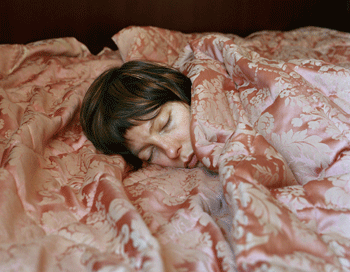
Aino Kannisto, Untitled (Woman Sleeping), 2008
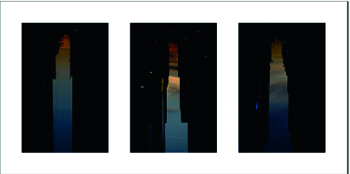
Peter Wegner, Buildings Made of Sky VI, 2009
.gif)
Laura Letinsky, Untitled #3, 2009, from the series The Fall
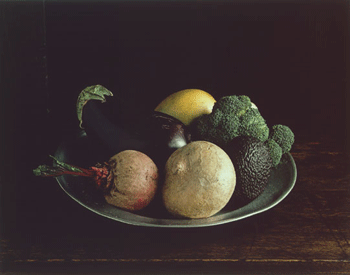
Evelyn Hofer
Broccoli (Still life No. 3), New York 1996
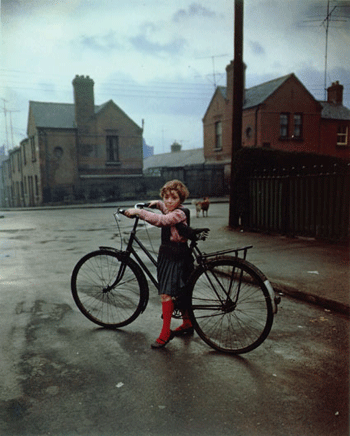
Evelyn Hofer
Girl with Bicycle, Dublin 1966
Evelyn Hofer
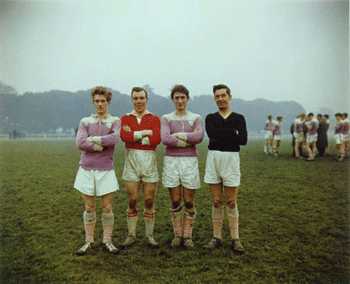
Phoenix Park on a Sunday, Dublin 1966
Evelyn Hofer
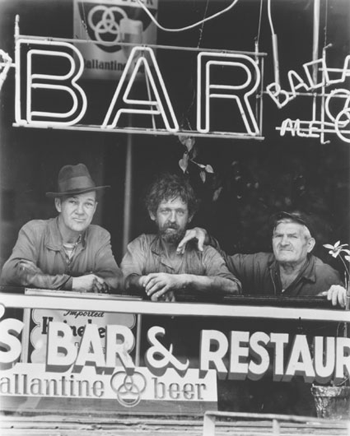
Bowery, New York 1965

Thomas Florschuetz, Jets 28 , 2008
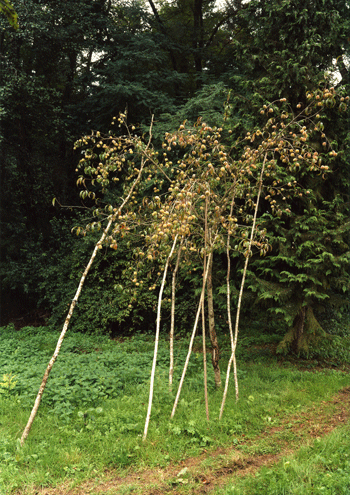
Simone Nieweg, Pfirsichbaum mit Stützen, Montagney, Haute-Saône, 2006
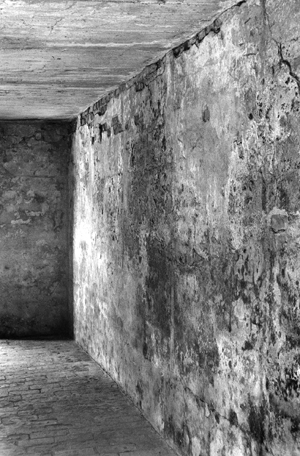
Dirk Reinartz, deathly still, 1993
Stutthof, Gas Chamber
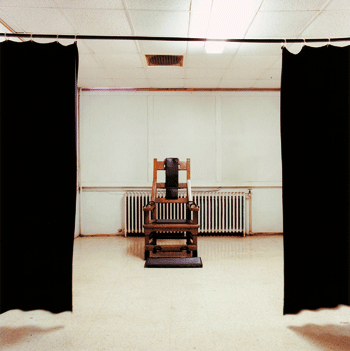
Lucinda Devlin
Electric Chair, Indiana State Prison, Michigan City, Indiana, 1991
from
|
|
DANS LA NUIT
“Dans la nuit” will be the thematic scope of the presentation at Paris Photo 2009, which comprises descriptive as well as metaphoric aspects.
The film stills „Kiss“ (2009) by Melanie MANCHOT show a young couple during a nocturnal bus ride through London. The artist teases out intimacy and privateness in public encounters. Thus she points to certain images of longings, states of being and motivations that makes the noise of the world around go away. "Kiss" has been shown at the Théâtre du Châtelet in Paris on October 3th 2009 on the occasion of the Nuit Blanche. Please click here to get a picture of this installation.
Within the work of Aino KANNISTO night time scenarios consistently play a role. The situations, in that the female protagonist finds herself remains mysterious and indefinable. Kannisto assumes a variety of different persons, creating a psychological and emotional density within the image. The staged situations usually remain ambivalent, left up to individual interpretation. The Finnish artist Kannisto knows how to create tension without revealing an obvious cause. The anonymity of the scenes as well as the protagonists behavior create a particular mood. Along with the narrative aspect that is integral to her photographs, they are also remarkable for their compositions, which the artist meticulously arranges down to the last detail. Here, the interplay of color and light evokes a host of intriguing allusions, opening the way for a further, purely formal, way of seeing the picture.
There are silver gelatine prints of Evelyn HOFER, that she made in the 60s by night. She directs our attention to places, which provide a specific attraction in the night (for example Washington Monument). Or she documents particular situations, only taking place in the night as the cleaning of St. Pancras, the railway station in London.
Furthermore and for the first time in Paris we bring along photographs by the American artist Peter WEGNER, whose structural works reflect the openness, he experience his resp. our environment. In „Buildings Made of Sky“ each image documents the space between buildings. When the photograph is inverted, this negative space takes on the proportions and rough outline of another building – a building made of neither brick nor steel, but rather a building made of sky. Since Wegner began this series in Manhattan in 2004, the project has grown to include other cities and various times of day. The two works in this exhibition depict the moments just after daybreak or the moments just before dusk.
Again and again night follows day, when the activity or – referring to the still lifes by Laura LETINSKY – dinners take place. The Canadian photographer stages remains of such meetings and therefore also the remembrance of them resp. the transience. The artist has developed her own pictorial aesthetic in her still lifes, one based on a painterly quality that expresses a special kind of languid beauty. Gentle color gradients reflect subtle lighting conditions and contrast with sculptural objects that stand out starkly from their surroundings, seeming to take on a life of their own. The obvious staging of the objects as well as the concealment of any point of spatial reference repeatedly challenge our faculties of perception anew.
Another artist which we will represent at Paris for the first time is Simone NIEWEG.
She belongs to the second generation of Becher students at the Kunstakademie in Düsseldorf. Devoid of human presence, these quietly beautiful colour photographs nonetheless attest to the profound human intervention in those landscapes on the outskirts of the cities. Nieweg's images are carefully balanced compositions which radiate a sense of precise perception and pure description. At the same time, her pictures are imbued with a subtle sensuousnes.
Galerie m Bochum will show new photographs of Thomas FLORSCHUETZ from the series „Jets“. Military planes stand for war and destruction, which are emblematised by the night. We would like to point out that this is only one reading of this work. Above all the quality of these photographs consists in the abstraction and physicalness of the subject.
The oeuvre of Thomas Florschuetz leads the spectator beyond a pure documentation of the chosen subjects. In fact, they undertake a new measurement of the view within individual systems of experience. They unfold a dialogue that underlines the fragmentary nature of our senses, of cognition and perception and invites us to the creative world of art. Apart from the motif itself – the cool, technological elegance of airplanes – it is the aesthetic and formal structure of these photographs that makes them into a completely autonomous artwork. As seen throughout Florschuetz’s oeuvre, the object, or more precisely the fragment of an object, develops here a presence and corporeality all its own.
In 1994 Dirk REINARTZ published the photo-documentary deathly still, a pictorial analysis of the Holocaust that evokes memories of that tragic era while prompting reflection on present-day conditions. He took the photographs over a period of eight years in 26 former German concentration and death camps. In observing these images of what the sites look like today, our sense of alienation comes not so much from the immediate immanence of the motifs themselves, but rather from the ordinariness and apparent meaninglessness of woods, fields, roads and overgrown walls that were once mute witnesses to unspeakable horrors. Our sense of unease comes from knowing that these scenes were photographed in concentration camps, with all the associations thus evoked.
Deathly still was exhibited for the first time in 1994, at Galerie m Bochum, and has since been on display in 20 museums all over the world. A book of the same name was published by Steidl Verlag, Göttingen.
|
|


